0017: Attachments
- Author: Daniel Hardman daniel.hardman@gmail.com, Sam Curren
- Start Date: 2018-12-24
Status
- Status: ACCEPTED
- Status Date: 2018-01-31
- Status Note: Used in a number of other RFCs.
Summary
Explains the three canonical ways to attach data to an agent message.
Motivation
DIDComm messages use a structured format with a defined schema and a small inventory of scalar data types (string, number, date, etc). However, it will be quite common for messages to supplement formalized exchange with arbitrary data--images, documents, or types of media not yet invented.
We need a way to "attach" such content to DIDComm messages. This method must be flexible, powerful, and usable without requiring new schema updates for every dynamic variation.
Tutorial
Messages versus Data
Before explaining how to associate data with a message, it is worth pondering exactly how these two categories of information differ. It is common for newcomers to DIDComm to argue that messages are just data, and vice versa. After all, any data can be transmitted over DIDComm; doesn't that turn it into a message? And any message can be saved; doesn't that make it data?
What it is true that messages and data are highly related, some semantic differences matter:
-
Messages are primarily about communication. Their meaning is tied to a communication context. Messages are a mechanism whereby state evolves in a protocol. Protocols are versioned according to the structure and semantics of messages. Messages are usually small, consisting of a modest number of fields with a structure that's focused on furthering the goals of their protocol.
-
Data has meaning at rest, in many different DIDComm protocols, or in important contexts beyond DIDComm. Data may be very large and very complex. It may come in formats that are quite independent from DIDComm. Data may be produced, consumed or handled as part of a protocol, but the actual content of the data is usually not where processing at the protocol level focuses. In agent codebases, it would be common for data handling to be implemented in different classes or libraries from the handlers for messages.
Some examples:
-
A protocol to negotiate the release of medical records might cause X-Rays, genomes, and many other artifacts to be transmitted. These artifacts are data, whereas the information packets that arrange the transmission and provide a carrying mechanism for the artifacts are messages.
-
A DIDComm message can be used to report an error. Descriptive parameters that change how the error is processed are probably part of the message, whereas a log file that provides supporting information should be thought of as data rather than the message proper.
-
The protocol for issuing credentials consists of messages that flow through certain steps. One of the steps eventually delivers a credential. The credential is data; it has meaning even when the protocol is complete, and the protocol version may evolve independent of the data format of the credential itself. The fact that the credential is transmitted through a message does not change the credential's primary status as data.
-
A protocol to schedule a venue for an event might produce a confirmation message when it finishes. This message might include a map of the venue, instructions about how to unlock the gate, pictures of certain resources, and so forth. This collateral is data, whereas the messages that signal progression through the steps of scheduling are not.
-
The Connection Protocol exchanges messages to establish a connection between two parties. Part of what's exchanged is a DID Doc. The DID Doc is more like data than it is like an ordinary message, since it has meaning at rest and outside the protocol.
The line between these two concepts may not be perfectly crisp in all cases, and that is okay. It is clear enough, most of the time, to provide context for the central question of this HIPE, which is:
How do we send data through messages?
3 Ways
Data can be "attached" to DIDComm messages in 3 ways:
- Inlining
- Embedding
- Appending
Inlining
In inlining, data is directly assigned as the value paired with a JSON key
in a DIDComm message. For example, a DID Document is inlined as the
value of the did_doc key in connection_request and
connection_response messages in the Connection
1.0 Protocol:
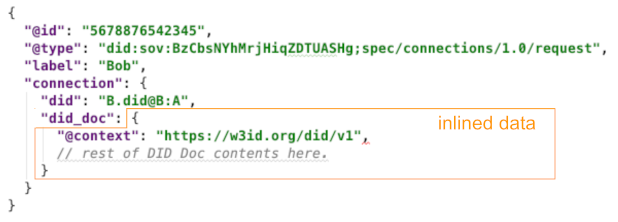
Notice that DID Docs have a meaning at rest, outside the message that conveys them. Notice as well that the versioning of DID Doc formats may evolve independent of the versioning of the connection protocol.
Only JSON data can be inlined, since any other data format would break JSON format rules.
Embedding
In embedding, a JSON data structure called an attachment descriptor
is assigned as the value paired with a JSON key in a DIDComm message. (Or, an array of
attachment descriptors could be assigned.) By convention, the key name for such
attachment fields ends with ~attach, making it a field-level decorator that
can share common handling logic in agent code. The attachment descriptor structure
describes the MIME type and other properties of the data, in much the
same way that MIME headers and body describe and contain an attachment
in an email message. Given an imaginary protocol that photographers could
use to share a their favorite photo with friends, the embedded data might
manifest like this:
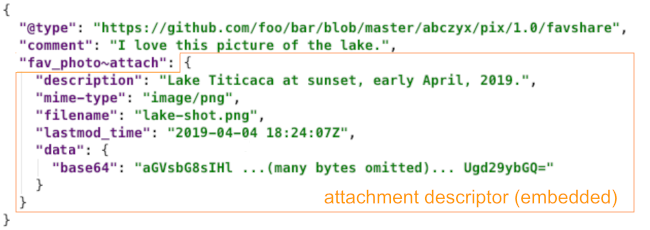
Embedding is a less direct mechanism than inlining, because the data is no longer readable by a human inspecting the message; it is base64-encoded instead. A benefit of this approach is that the data can be any MIME type instead of just JSON, and that the data comes with useful metadata that can facilitate saving it as a separate file.
Appending
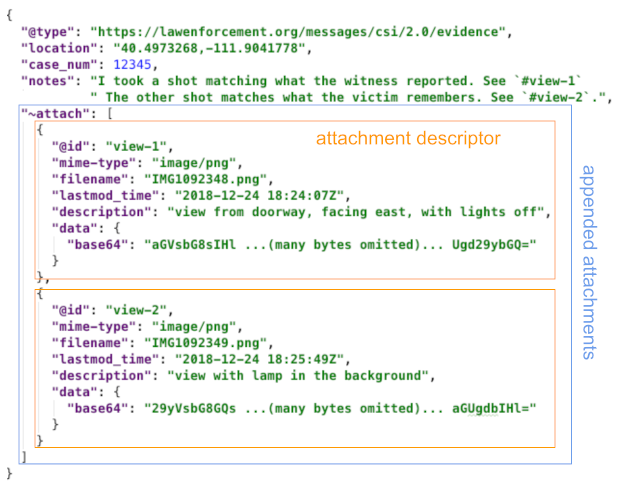
Appending is accomplished using the ~attach decorator, which can be added to any
message to include arbitrary data. The decorator is an array of attachment
descriptor structures (the same structure used for embedding). For example, a
message that conveys evidence found at a crime scene might include the
following decorator:
Choosing the right approach
These methods for attaching sit along a continuum that is somewhat like the continuum between strong, statically typed languages versus dynamic, duck-typed languages in programming. The more strongly typed the attachments are, the more strongly bound the attachments are to the protocol that conveys them. Each choice has advantages and disadvantages.
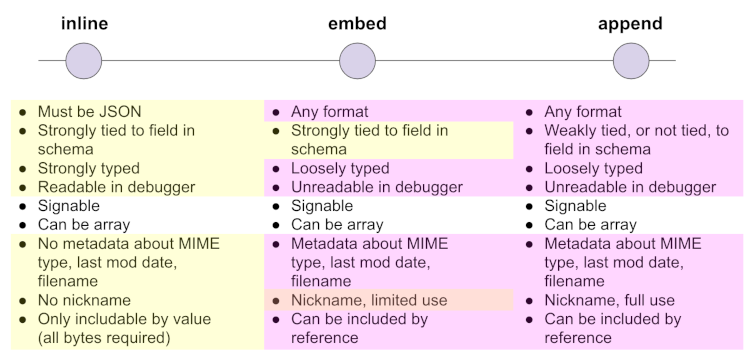
Inlined data is strongly typed; the schema for its associated
message must specify the name of the data field, plus what type
of data it contains. Its format is always some kind of JSON--often
JSON-LD with a @type and/or @context field to provide greater
clarity and some independence of versioning. Simple and small data
is the best fit for inlining. As mentioned earlier, the Connection
Protocol inlines a DID Doc in its connection_request and
connection_response messages.
Embedded data is still associated with a known field in the message schema, but it can have a broader set of possible formats. A credential exchange protocol might embed a credential in the final message that does credential issuance.
Appended attachments are the most flexible but also the hardest to run through semantically sophisticated processing. They do not require any specific declaration in the schema of a message, although they can be referenced in fields defined by the schema via their nickname (see below). A protocol that needs to pass an arbitrary collection of artifacts without strong knowledge of their semantics might find this helpful, as in the example mentioned above, where scheduling a venue causes various human-usable payloads to be delivered.
IDs for attachments
The @id field within an attachment descriptor is used to refer unambiguously
to an appended (or less ideally, embedded) attachment, and works like an HTML
anchor. It is resolved relative to the root @id of the message and only has
to be unique within a message. For example,
imagine a fictional message type that's used to apply for an art scholarship,
that requires photos of art demonstrating techniques A, B, and C.
We could have 3 different attachment descriptors--but what if the same
work of art demonstrates both technique A and technique B? We don't want
to attach the same photo twice...
What we can do is stipulate that the datatype of A_pic, B_pic, and C_pic
is an attachment reference, and that the
references will point to appended attachments. A fragment of the result might
look like this:
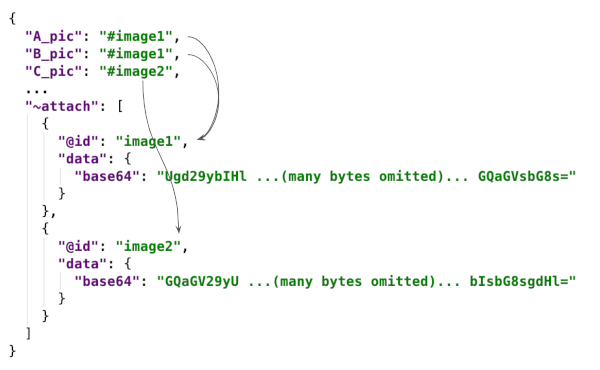
Another example of nickname use appeared in the first example of
appended attachments above, where the notes field
refered to the @ids of the various attachments.
This indirection offers several benefits:
- The same attachment may be referenced at more than one place in the schema, without duplicating the content.
- The message may now include any number of attachments besides the 3 that are required, and mingle them freely with the others. (In our example, perhaps the student wants to add side and overhead shots of each work of art, not just front views).
- Attachments may now have formal semantics, instead of requiring human intelligence to handle. (How many times have we written emails with multiple attachments, and added verbiage like, "My photo of the door is attached as image1.jpeg; my photo of the damaged trunk is attached as image2.jpeg"?)
We could use this same technique with embedded attachments (that is, assign a nickname to an embedded attachment, and refer to that nickname in another field where attached data could be embedded), but this is not considered best practice. The reason is that it requires a field in the schema to have two possible data types--one a string that's a nickname reference, and one an attachment descriptor. Generally, we like fields to have a single datatype in a schema.
Content Formats
There are multiple ways to include content in an attachment. Only one method should be used per attachment.
base64
Base64 content encoding is an obvious choice for any content different than JSON. You can embed content of any type using this method. Examples are plentiful throughout the document.
json
If you are embedding an attachment that is JSON, you can embed it directly in
JSON format to make access easier, by replacing data.base64 with data.json,
where the value assigned to data.json is the attached content:
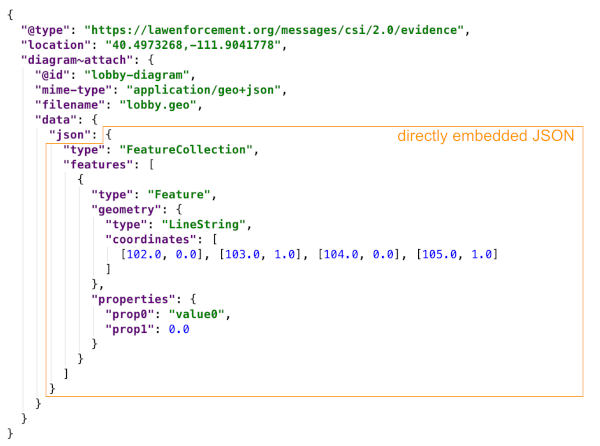
This is an overly trivial example of GeoJSON,
but hopefully it illustrates the technique. In cases where there is no mime type
to declare, it may be helpful to use JSON-LD's @type construct
to clarify the specific flavor of JSON in the embedded attachment.
links
All examples discussed so far include an attachment by value--that is, the attachment's bytes are directly inlined in the message in some way. This is a useful mode of data delivery, but it is not the only mode.
Another way that attachment data can be incorporated is by reference. For
example, you can link to the content on IPFS by replacing data.base64
or data.json with data.links in an attachment descriptor:
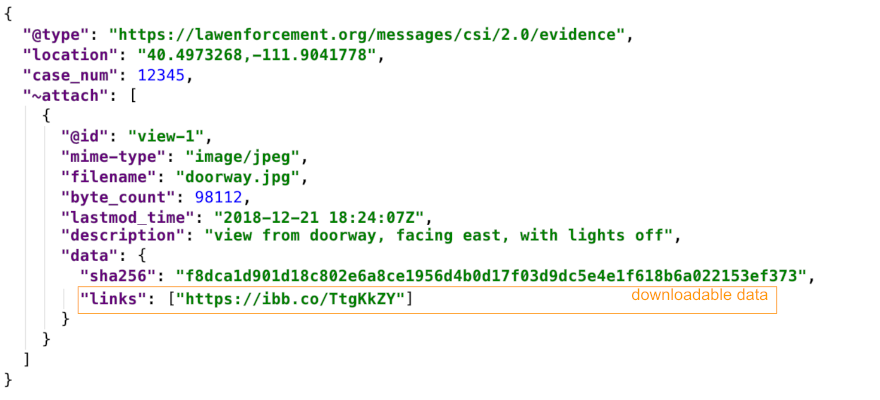
When you provide such a link, you are creating a logical association between the message and an attachment that can be fetched separately. This makes it possible to send brief descriptors of attachments and to make the downloading of the heavy content optional (or parallelizable) for the recipient.
IPFS is not the only option for attaching by reference. You can do the same
with S3 (showing just the data fragment now):
"data": {
  "sha256": "1d4db525c5ee4a2d42899040cd3728c0f0945faf9eb668b53d99c002123f1ffa",
  "links": ["s3://mybucket/mykeyoyHw8T7Afe4DbWFcJYocef5"]
}
Or on an ordinary HTTP/FTP site or CDN:
"data": {
  "links": ["https://github.com/sovrin-foundation/launch/raw/master/sovrin-keygen.zip"]
}
Or on BitTorrent:
"byte_count": 192834724,
"data": {
  "links": ["torrent://content of a .torrent file as a data URI"]
}
Or via double indirection (URI for a BitTorrent):
"data": {
  "links": ["torrent@http://example.com/mycontent.torrent"]
}
Or as content already attached to a previous DIDComm message:
"data": {
  "links": ["didcomm://my-previous-message-id.~attach#id"]
}
Or even via a promise to supply the content at some point in the future, in a subsequent DIDComm message:
"data": {
  "links": ["didcomm://fetch"]
}
[TODO: how does the message that actually delivers this content refer back to the promise made earlier, to claim it has been fulfilled?]
The set of supported URI types in an attachment link is not static, and recipients of attachments that are incorporated by reference are not required to support all of them. However, they should at least recognize the meaning of each of the variants listed above, so they can perform intelligent error handling and communication about the ones they don't support.
The links field is plural (an array) to allow multiple locations to be
offered for the same content. This allows an agent to fetch attachments using
whichever mechanism(s) are best suited to its individual needs and capabilities.
[TODO: discuss sending an empty message with just attachments, and how to request a send of an attachment, or an alternate download method for it]
Size Considerations
DIDComm messages should be small, as a general rule. Just as it's a bad idea to send email messages with multi-GB attachments, it would be bad to send DIDComm messages with huge amounts of data inside them. Remember, a message is about advancing a protocol; usually that can be done without gigabytes or even megabytes of JSON fields. Remember as well that DIDComm messages may be sent over channels having size constraints tied to the transport--an HTTP POST or Bluetooth or NFC or AMQP payload of more than a few MB may be problematic.
Size pressures in messaging are likely to come from attached data. A good rule of thumb might be to not make DIDComm messages bigger than email or MMS messages--whenever more data needs to be attached, use the inclusion-by-reference technique to allow the data to be fetched separately.
Security Implications
Attachments are a notorious vector for malware and mischief with email. For this reason, agents that support attachments MUST perform input validation on attachments, and MUST NOT invoke risky actions on attachments until such validation has been performed. The status of input validation with respect to attachment data MUST be reflected in the Message Trust Context associated with the data's message.
Privacy Implications
When attachments are inlined, they enjoy the same security and transmission guarantees as all agent communication. However, given the right context, a large inlined attachment may be recognizable by its size, even if it is carefully encrypted.
If attachment content is fetched from an external source, then new complications arise. The security guarantees may change. Data streamed from a CDN may be observable in flight. URIs may be correlating. Content may not be immutable or tamper-resistant.
However, these issues are not necessarily a problem. If a DIDComm message wants to attach a 4 GB ISO file of a linux distribution, it may be perfectly fine to do so in the clear. Downloading it is unlikely to introduce strong correlation, encryption is unnecessary, and the torrent itself prevents malicious modification.
Code that handles attachments will need to use wise policy to decide whether attachments are presented in a form that meets its needs.
Reference
Attachment Descriptor structure
-
@id: A JSON-LD construct that uniquely identifies attached content within the scope of a given message. Recommended on appended attachment descriptors. Possible but generally unused on embedded attachment descriptors. Never required if no references to the attachment exist; if omitted, then there is no way to refer to the attachment later in the thread, in error messages, and so forth. Because@idis used to compose URIs, it is recommended that this name be brief and avoid spaces and other characters that require URI escaping. -
description: An optional human-readable description of the content. -
filename: A hint about the name that might be used if this attachment is persisted as a file. It is not required, and need not be unique. If this field is present andmime-typeis not, the extension on the filename may be used to infer a MIME type. -
mime-type: Describes the MIME type of the attached content. Optional but recommended. -
lastmod_time: A hint about when the content in this attachment was last modified. -
byte_count: Optional, and mostly relevant when content is included by reference instead of by value. Lets the receiver guess how expensive it will be, in time, bandwidth, and storage, to fully fetch the attachment. -
data: A JSON object that gives access to the actual content of the attachment. Contains the following subfields: -
sha256: The hash of the content. Optional. Used as an integrity check if content is inlined. if content is only referenced, then including this field makes the content tamper-evident. This may be redundant, if the content is stored in an inherently immutable container like content-addressable storage. This may also be undesirable, if dynamic content at a specified link is beneficial. Including a hash without including a way to fetch the content via link is a form of proof of existence. -
links: A list of zero or more locations at which the content may be fetched.
Drawbacks
By providing 3 different choices, we impose additional complexity on agents that will receive messages. They have to handle attachments in 3 different modes.
Rationale and alternatives
Originally, we only proposed the most flexible method of attaching--appending. However, feedback from the community suggested that stronger binding to schema was desirable. Inlining was independently invented, and is suggested by JSON-LD anyway. Embedding without appending eliminates some valuable features such as unnamed and undeclared ad-hoc attachments. So we ended up wanting to support all 3 modes.
Prior art
Multipart MIME (see RFCs 822, 1341, and 2045) defines a mechanism somewhat like this. Since we are using JSON instead of email messages as the core model, we can't use these mechanisms directly. However, they are an inspiration for what we are showing here.
Unresolved questions
- What additional clarity do we need to provide for the URIs used to fetch attachment content later?