Query Connection State Protocol 1.0
Summary
Describes how parties using peer DIDs can ask one another to resolve DIDs to DID docs. This is considered a minor protocol because synchronizing DID docs, not simply resolving a peer DID to a DID doc, will be the more common and more robust operation. See the Sync Connection Protocol.
Motivation
We need a way to ask another party to do simple resolution of peer DIDs for us.
Tutorial
Name and Version
This RFC defines the query_connection_state protocol, version 1.x, as identified by the
following PIURI:
did:sov:BzCbsNYhMrjHiqZDTUASHg;spec/query_connection_state/1.0
Of course, subsequent evolutions of the protocol will replace 1.0 with
an appropriate update per semver
rules.
Roles
This is a classic two-step request-response interaction,
so it uses the predefined roles of requester and responder.

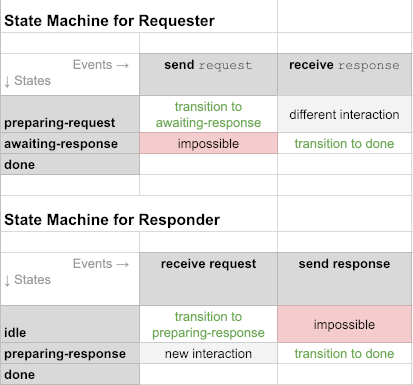
State Machines
The state machines for this protocol are standard, too:
Messages
state_request
This message is sent by the requester. It asks the responder to report the
state it knows for a particular connection. It is essentially a request for a DID doc,
so it plays the same role as DID resolution to a DID doc when a ledger is queried. It
looks like this:
{
  "@type": "did:sov:BzCbsNYhMrjHiqZDTUASHg;spec/query_connection_state/1.0/state_request",
  "@id": "6a4986dd-f50e-4ed5-a389-718e61517207",
  "for": "did:peer:11-479cbc07c3f991725836a3aa2a581ca2029198aa420b9d99bc0e131d9f3e2cbe",
  "as_of_hash": "d48f058771956a305e12a3b062a3ac81bd8653d7b1a88dd07db8f663f37bf8e0",
  "as_of_time": "2019-07-23 18:05:06.123Z"
}
The properties of this message include:
@typeand@id: Required. Standard for DID Comm messages.for: Required. A DID that identifies which state is being queried.as_of_time: Optional. The timestamp for which state is being queried. If this property is omitted or equal tonull, andas_of_hashis also omitted, then the state as of "now" is what the sender is asking for.as_of_hash: Optional, and mutually exclusive withas_of_time. Identifies a specific state that is being queried, by the hash of that state. Optional. Using this property is somewhat unusual, because the sender of the message has to know to know of a state's hash, without knowing the state itself. This may be helpful for advanced use cases.
The two optional properties are rarely used. The simplest and most
common form of the message contains only @type, @id, and for.
Familiar DID Communications decorators can be used with this message.
For example, to note that the request will expire or grow stale if
not serviced quickly, ~timing.expires_time or ~timing.stale_time
can be added. Other decorators could be used to describe the preferred
route to use in the return response, and so forth.
state_response
This message is the response to a state_request message, and looks like this:
{
  "@type": "did:sov:BzCbsNYhMrjHiqZDTUASHg;spec/query_connection_state/1.0/state_response",
  "@id": "1517207d-f50e-4ed5-a389-6a4986d718e6",
  "~thread": { "thid": "6a4986dd-f50e-4ed5-a389-718e61517207" },
  "for": "did:peer:11-479cbc07c3f991725836a3aa2a581ca2029198aa420b9d99bc0e131d9f3e2cbe",
  "did_doc": {
      // full content of resolved variant of DID Doc here
  },
  "as_of_time": "2019-07-23 18:05:06.123Z"
}